UNITED STATES DISTRICT COURT
DISTRICT OF MINNESOTA
FOURTH DIVISION
Civ. 4-74-121
FINAL JUDGMENT
Minnesota Youth Symphony, a Minnesota corporation,
on behalf of itself and its members and
Diana Kodner, a minor, by her father and natural guardian, Howard Kodner; Stephanie Mrozla, a minor, by her father and natural guardian, Marc A. Mrozla; Heather Scott, a minor, by her father and natural guardian, Edward I. Scott; John Wasson, a minor, by his mother and natural guardian, Luella L. Wasson; Janeen Keller, a minor, by her father and natural guardian, Donald Keller; Kim Loos, a minor, by his father and natural guardian, Davis Loos; and Marjorie Meier, a minor, by her mother and natural guardian, Rosemary Meier,
Plaintiffs,
v.
Minnesota Music Educators Association,
Oscar B. Dahle, Donald Gjerdrum, Linville Doan, Richard Papke, Richard Aune, Charles Olson, Carol Palmquist, Mark Lammers, James R. Gronseth, James Colosimo, Stan Kindzerski, Walt Lindberg, Joe Fennie, Robert Hotvet, David Jordahl, Russell Pesola, Glenn Evensen, Robert Iverson, Fred Arnold, Gloria Kiester, David Price
Defendants.
Plaintiffs having filed their amended complaint on June 27, 1975, and the parties hereto having consented to the entry of this judgment without trial or adjudication of any issue of fact or law,
NOW, THEREFORE, prior to the taking of any testimony, before the adjudication of any issue of law or fact, and upon the consent of the parties hereto,
IT IS HEREBY ORDERED, ADJUSGED AND DECREED AS FOLLOWS:
I. Jurisdiction
This Court has jurisdiction over the subject matter of this action and personal jurisdiction over the defendants to the complaint. The amended complaint states claims upon which relief may be granted under section 1983 of Title 42 of the United States Code.
II. Definitions
As used in this Final Judgment:
A. “To Discriminate” or “Discriminating” means the failure to treat Minnesota Youth Symphony (M.Y.S.) equally with all other “non-public school” musical organizations, and/or the failure to treat actual or prospective members of M.Y.S. equally with all other actual or prospective members of other non-public school musical organizations.
B. “Prospective members of M.Y.S.” means any public school students which might be, in any manner, interested in, suitable for or eligible for participation in M.Y.S.
C. “School facilities” means any instrumentality which is in any manner controlled by any public school in the State of Minnesota, including, without limitation, school bulletin boards, school music rooms, school auditoriums and school musical instruments.
III. Applicability
The provisions of this Final Judgment shall apply to the defendants and to each of their officers, directors, agents, employees, successors and assigns, and to all other persons in active concert of participation with the defendants who shall have received actual notice of this Final Judgment by personal service or otherwise.
IV. Prohibited Acts
Defendants are hereby enjoined and restrained from:
A. In any manner intimidating, threatening or coercing, or attempting to intimidate, threaten or coerce any actual or prospective member of M.Y.S. with the purpose of interfering with his or her full and equal enjoyment of the goods, services, facilities, benefits, privileges and advantages of public school attendance on the ground of that person’s actual or prospective membership in M.Y.S.
B. In any manner deterring, hindering or impeding, or attempting to deter, hinder or impede, students from joining M.Y.S. or from participating in M.Y.S. activities.
C. Withholding, denying, or attempting to withhold or deny, or depriving, or attempting to deprive, any actual or prospective member of M.Y.S. of the full and equal enjoyment of the goods, services, facilities, benefits, privileges and advantages of public school attendance on the ground of that person’s actual or prospective membership in M.Y.S.
D. In any manner discriminating, or attempting to discriminate, against actual or prospective members of M.Y.S. who are public school students by reason of said students’ actual or prospective membership in M.Y.S., including, without limitation:
(1) Discriminating, or attempting to discriminate, in the use, right to use or opportunity to use school facilities;
(2) Discriminating, or attempting to discriminate, in the awarding of grades; and
(3) Discriminating, or attempting to discriminate, in the right to attend or otherwise participate in M.Y.S. concert or rehearsal sessions.
E. In any manner discriminating, or attempting to discriminate, against M.Y.S., including, without limitation:
(1) Discriminating, or attempting to discriminate, against M.Y.S. in the posting of audition and/or promotional materials on school bulletin boards controlled by the defendants; and
(2) Discriminating, or attempting to discriminate, against M.Y.S. in the recruitment of members among public school students.
F. In any matter intimidating, threatening or coercing, or attempting to intimidate, threaten or coerce, any person from becoming or continuing as a music director or conductor of M.Y.S.
G. Engaging in any conspiracy or plan with the intent of hindering, impeding or precluding M.Y.S. from full participation in the Minnesota musical community on an equal basis with all other musical groups, including without limitation, engaging in such conspiracy or plan with respect to M.Y.S. fundraising activities.
V. MMEA Resolutions – Other Writings
MMEA is hereby ordered and directed to forthwith rescind the 1967, 1973 and 1975 resolutions passed by said organization concerning extracurricular musical organizations and their relationship with school instrumental programs. To ameliorate any harm to the reputations of M.Y.S. and its former music director, Ralph Winkler, which may have resulted from the passage of the 1973 and 1975 resolutions, and accusations made against M.Y.S. and Ralph Winkler in letters and telegrams sent on behalf of the Minnesota Music Educators Association to persons in Minnesota and elsewhere, MMEA shall prominently publish in the October, 1977 issue of Gopher Music Notes, the official publication of the Minnesota Music Educators Association, separate and apart from the publication of this entire final judgment, using as a format the manner of publication of the aforementioned 1975 resolution, the following:
“In the 1973 and 1975 Resolutions of MMEA titles ‘Concerning Extra-Curricular Musical Organizations and Their Relationship with School Instrumental Programs’ and in certain letters and telegrams written on behalf of MMEA, M.Y.S. and its former music director, Ralph Winkler, were charged with certain unethical and unprofessional behavior and a deliberate failure to cooperate with MMEA and public school music directors.
Pre-trial discovery conducted by M.Y.S. and on file with the United States District Court for public review in the action brought by M.Y.S. against MMEA and certain individuals who are 17 of its past and present officers, directors and ex-officio officers and naming certain individuals as co-conspirators has revealed that these charges were false and unfounded.
MMEA hereby apologizes to M.Y.S., its members and conductors for making such charges. It is suggested that readers place a copy of this notice on their school music bulletin boards.”
As used herein, the manner of publication of the 1975 resolution shall mean the following: The preceding paragraph and this final judgment shall be printed on green paper with the preceding paragraph being printed on the first page under the caption “Notice M.M.E.A. Members” in the same manner as the notice form used for the 1975 resolution. In addition, the first page shall advise members of MMEA of the revocation of the 1967, 1973 and 1975 resolutions. The foregoing shall be placed in a bold-faced box as in the 1975 resolution. Nothing more shall be contained on the first page. The final judgment and stipulation of the parties shall be printed on green paper on the pages immediately following the above notice. The foregoing shall be firmly affixed into the middle of the Gopher Music Notes.
VI. Stipulation of Parties
The Court hereby adopts as part of this Final Judgment the following stipulations of the parties:
A. MMEA School Participation Policy: MMEA will adopt the following policy as to student participation in public school instrumental groups:
The MMEA realizes that its members cannot require students to belong to their respective public school instrumental groups. MMEA, therefore, only strongly recommends that a student who belongs to a non-school youth orchestra is also a member of his/her public school instrumental group. Neither the MMEA, nor any of its members, may legally require that a student be enrolled in any public school music organization as a prerequisite in any non-school music organization, such as the M.Y.S. The MMEA further realizes that students cannot be required to secure authorization from their school music director and/or principal as a condition to participation in non-school music organizations.
B. Apology of MMEA: MMEA hereby acknowledges that certain of its members who were also founders and/or board members and conductors of a non-school youth symphony organization (Greater Twin Cities Youth Symphonies) specifically created to become the one and only non-school youth symphony resource in this area have engaged in questionable conduct in the past toward and concerning M.Y.S., its music director and conductors and certain of its members. MMEA wishes to formally apologize to everyone in the Minnesota music community, including M.Y.S., for any harm which may have been caused by such conduct.
C. Scheduling: The defendants and M.Y.S. agree to make reasonable efforts to avoid conflicting concert dates. It must be recognized that merely because one group schedules a concert date earlier than the other does not mean that the latter cannot schedule a conflicting date. All that is intended here is that the parties make reasonable, good-faith efforts to avoid conflicts.
MMEA also recognizes that school music directors cannot discriminate in awarding grades, or deny students the right to earn credits, in a regularly offered school music course if the student should decide to play in a non-school concert which conflicts with a school concert scheduled outside of normal school hours. However, if an organization is completely extracurricular, in that it is not offered for credit and only meets out of normal school hours, attendance at activities outside of normal school hours can be required as a condition of continued membership in the organization.
VII. Notice
Defendants are ordered and directed, within thirty (30) days of the date of entry of this Final Judgment, to personally serve a copy of this Final Judgment upon the following persons: Richard Sieber; Stephen Sell; Lawrence Gibson; William Jones; Richard Negaard; James Chlebecek; George Chlebecek; James Peterson.
Defendants are ordered and directed, within thirty (30) days from the date of entry of this Final Judgment, to serve a copy of this Final Judgment by registered mail upon the following persons: Marvin Rabin; Thomas Jensen; James Hainlen.
Defendants are ordered and directed, within thirty (30) days from the date of entry of this Final Judgment, to service by mail, in accordance with the Rules of Civil Procedure, a copy of this Final Judgment upon each K-through-12 public school music teacher and each college music instructor who is employed in public schools or colleges located in the counties of Hennepin, Ramsey, Anoka, Washington, Wright, Rice, Dakota, Scott, Goodhue, Carver, Olmstead, Stearns, Chisago, Wabasha, McLeod and Sherburne — as their names and addresses are set forth in the 1976-77 Directory of Minnesota Music Teachers as prepared by the MMEA — a copy of which directory will be sent to M.Y.S. upon request.
A copy of this Final Judgment shall be served by defendants by mail upon the Music Educators National Conference, American Symphony Orchestra League, American String Teachers Association and National School Orchestra Association.
An informational copy of this Final Judgment shall be served by defendants by mail upon the foundations and other concerns listed in Schedule A attached hereto.
Within ten (10) days of the service required by the Final Judgment, defendant shall file with this Court an affidavit attesting to completion of service required by this Final Judgment.
A copy of this Final Judgment shall be conspicuously published in the October 1977 issue of Gopher Music Notes using as a format the manner and publication of the aforementioned 1975 resolution.
VIII. Retention of Jurisdiction
Jurisdiction is retained for the purpose of enabling any of the parties to this Final Judgment to apply to this Court at any time for such further orders and directions as may be necessary or appropriate for the construction, implementation and/or modification of this Final Judgment, for the enforcement of compliance herewith and for the punishment of any violation of any of the provisions contained herein.

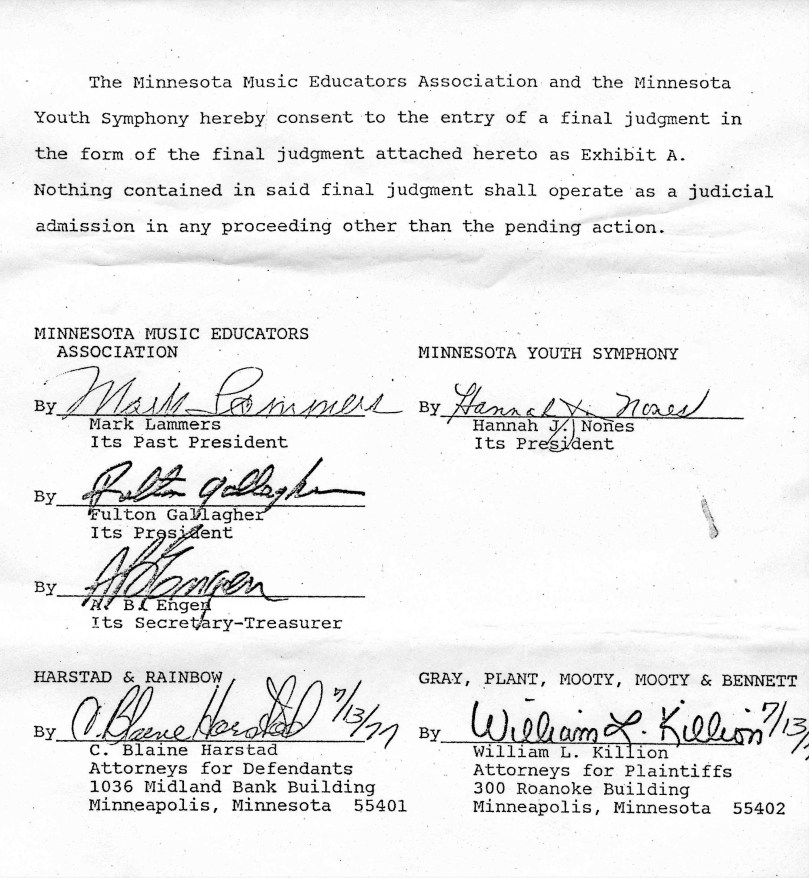 Filed September 22, 1977 by Harry A. Sieben, Clerk
___________________
Note:
All legal material, subpoenaed documents and exhibits pertaining to this lawsuit, along with all written transcripts of deposition of the defendants taken under oath, are on file at the U.S. Federal Court House. The above material under File No. Civ. 4-74-121 is open to the general public upon request for viewing at the Office of the Clerk of the:
U.S. District Court, Federal Building and U.S. Court House — Room 514, 110 South 4th Street, Minneapolis, MN USA

 On Education – by Charles B. Fowler
 Reprinted from Symphony News, Vol. 28, No. 6 (May 1978).
 The lawsuit was filed in June 1975 by MYS on behalf of itself and its members against the MMEA for reasons of discrimination. The Minnesota Civil Liberties Union argued the case for the MYS because it felt there were violations of students’ rights as stated in the first and fourteenth amendments [of the U.S. Constitution].
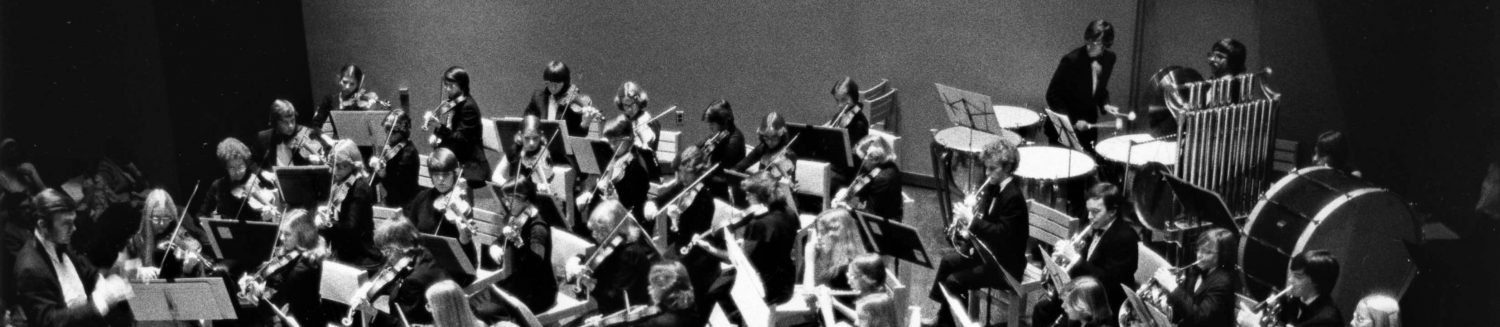
 Minnesota Youth Symphony 1977