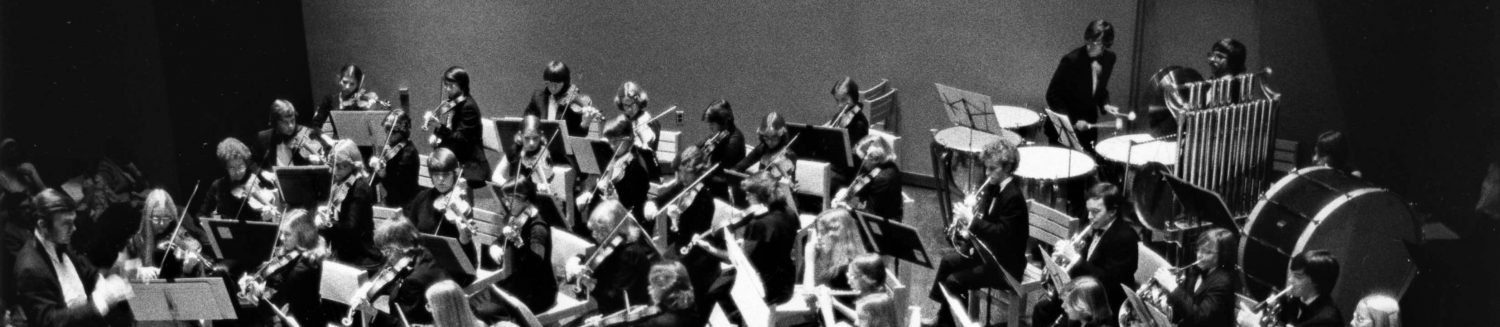

Courtesy: Musical America Archives – Musical America.com
 On Education – by Charles B. Fowler
Reprinted from High Fidelity/Musical America (December 1977).
You’ve heard that music teachers sometimes squabble? Well, few scraps match the intensity of the recent battle in Minnesota between the Minnesota Youth Symphony and the Minnesota Music Educators Association, a state affiliate of the Music Educators National Conference.
It seems that members of MMEA, who were also founders, board members and conductors of the Greater Twin Cities Youth Symphony, were determined that that orchestra be the one and only non-school youth symphony in the area. They used their influence within MMEA to pass resolutions in 1973 and 1975 “Concerning Extra-Curricular Musical Organizations and Their Relationship with School Instrumental Programs” and to send letters and telegrams on behalf of MMEA charging the Minnesota Youth Symphony and its former music director, Ralph Winkler, with certain unethical and unprofessional behavior and a deliberate failure to cooperate with MMEA and public school music directors.
To counter these charges the Minnesota Youth Symphony filed a complaint with the Federal District Court in Minneapolis against MMEA and seventeen of its past and present officers, directors, and ex-officio officers, naming certain individuals as co-conspirators. The Minnesota Civil Liberties Union agreed to take the case for the Youth Symphony because they felt there were definite violations of students’ constitutional rights involving the first and fourteenth amendments. In September 1977 Federal Judge Earl Larson ruled in favor of the Youth Symphony.
Some very important constitutional questions were raised in this case, mainly in regard to how much control the public school music educator can legally impose on students’ music activities outside of school. The control attempted by the MMEA was ruled illegal and it might well be that the results of the case will have national impact and repercussions, since other states are involved in similar practices.
Just what does the Final Judgment accomplish?
It stipulates that the MMEA cannot control the outside musical activities of students by requiring that they belong to their school orchestras as a prerequisite to joining a private youth symphony, or require authorization signatures from their school music director and/or principal. This may be the most far-reaching result of this case, because it strikes down the Code of Ethics of the American String Teachers Association. The most that MMEA can do is to “strongly recommend” participation in school instrumental groups.
The judgment orders MMEA to cease all discriminatory acts in the public schools against the Minnesota Youth Symphony, its student members and/or conductors. Legally this judgment protects students from being harassed and/or threatened in the public schools because they happen to participate in a non-school musical organization not to the liking of the music educator. This protects all students participating in any outside-of-school musical activity, including such groups as drum and bugle corps, church choirs, rock bands, etc. If the defendants and others served with the judgment violate its provisions, they can be declared in contempt of court and punished accordingly.
The judgment orders the MMEA to rescind the resolutions it passed that condemned the Minnesota Youth Symphony and instructed music educators to deny the symphony use of public school facilities and equipment and to actively discourage students from joining the symphony. It orders MMEA to publish an apology in its official publication as well as a copy of the final judgment.
The final judgment even specifies that the apology and final judgment shall be printed on green paper “in the same manner as the notice form used for the 1975 resolution.” It orders MMEA to advise its members of the revocation of the resolutions “in a bold-faced box as in the 1975 resolution.” It also asks MMEA and the Minnesota Youth Symphony to agree to make reasonable efforts to avoid conflicting concert dates. And it asks that a copy of the final judgment be served by the defendants upon the Music Educators National Conference, the American Symphony Orchestra League, the American String Teachers Association, and the National School Orchestra Association.
The case documents the unethical tactics of overzealous music teaches, who acted to obliterate a competing musical organization by discriminatory procedures and slander. It shows how the political power of a professional organization can be manipulated and corrupted for self-serving purposes.
Who are the losers? Such infighting is damaging to the music teaching profession and to the arts in general. By their lack of magnanimity these music teachers debased their own kind. But who loses the most? The students. Such tension and strife distract the learner and detract from the learning situation. Energies are misdirected. It’s a bad lesson in human relations.
But the case says something else that his even more disturbing: music is by no means an assured route to humanism. Generosity, love, esteem, honesty, appropriateness, forthrightness, integrity – these are traits as much apart from the arts as the sciences. At times the arts may reflect them, but the human being – even those in the closest association with music – may simply choose to look the other way.
 Reprinted from Symphony News, Vol. 28, No. 6 (May 1978).
 The lawsuit was filed in June 1975 by MYS on behalf of itself and its members against the MMEA for reasons of discrimination. The Minnesota Civil Liberties Union argued the case for the MYS because it felt there were violations of students’ rights as stated in the first and fourteenth amendments [of the U.S. Constitution].
 Minnesota Youth Symphony 1977